HISTORY: 8 September 2026 – 9 September 2026
REFERENCE: This page continues the preceding experiments. Particular reference is made to Experiment No. 23, which treats the subject matter of this contribution in great detail. The present contribution summarises the larger context once again and directs attention to the launch of the Citizen Server (BSS).
Author: The human Gerd Doeben-Henisch
Contact: info@emerging-life.org
Asymmetrical Symbiosis: After the format of ‘asymmetrical symbiosis’ has gone through several changes in this blog, the following format has now settled in. As a matter of principle, the human Gerd first writes his texts entirely by himself. Once they are finished, he enters into a meta-dialogue with a generative intelligence — so far ChatGPT and Claude Opus X. If this meta-dialogue was interesting enough in substance, and if the matters at hand go beyond everyday understanding, the author Gerd asks a generative AI to write its own commentary on one — or several — of the texts. The wording of this commentary is not altered by the author Gerd, so as not to obscure the distinctive character of the algorithmic AI perspective.
Transition to Experiment No. 27
Author: Gerd
After the author Gerd had reflected in many ways on the global perspective of life on planet Earth in 2023–2025, the individual human being — with his or her individual state of mind, embedded in real everyday situations — moved more and more into view.
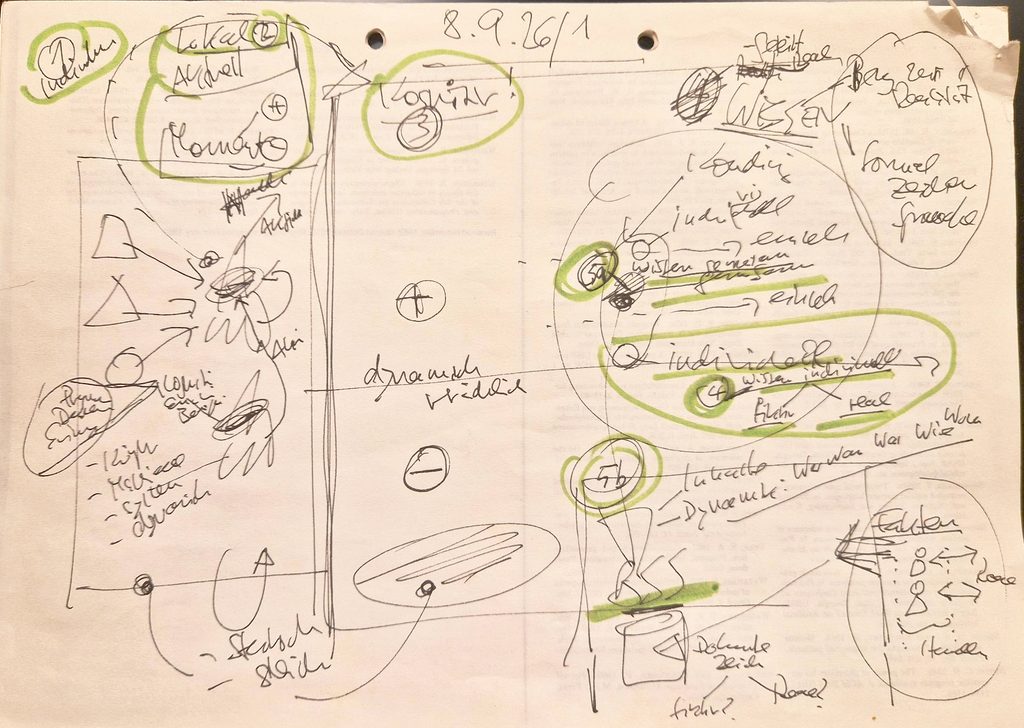
INFO: This graphic renders the thoughts that took place in the run-up to this text and that then became the occasion for writing what follows. Experience shows that the human Gerd only ever takes up a small part of the aspects of the image in the subsequent text.
Including the individual, with his or her concrete constitution, within a real everyday world made it possible to see the limits of the individual in a dynamic world more clearly. The future of all human individuals — who are part of life as a whole — can only succeed through the cooperation of all. This brings out the significance of communication and of shared knowledge: if one person does not know what another thinks and feels, no future-proof joint action can come about. When we ask how such shared communication for future-proof action can succeed, the concept of a ‘shared knowledge’ moves to the centre — a knowledge that exists by everyone and for everyone. A wonderful example of such a concept is Wikipedia. For shared, future-proof (‘resilient for the future’) action in everyday life, however, the concept of Wikipedia is not sufficient. What further is needed?
The Individual
Author: Gerd
Global life — with Homo sapiens as one sub-population — cannot be described adequately without the individuals at all. But how much of the individual does one have to understand in order to understand the larger, overarching phenomena of life adequately?
If one looks more closely at the development of life on Earth (also called ‘evolution’), there is no getting past the ‘building blocks of life’. If one takes the phenomenon of a ‘cell’ as the threshold between ‘inanimate matter’ and ‘animate matter’, it quickly becomes clear that the great diversity of ‘biological, cell-based life’ cannot be understood without considering the way cells function and how they interact.
The more complex a biological system is, the more one will stop considering the many trillions (10¹²) of individual cells in a human body one by one, and consider them instead in groups, assemblies, networks and organs. At the same time, one will try to capture the ‘behaviour of such larger units over time’. The possibilities of structure formation feel infinitely large.
At a very high level of abstraction, the following structuring suggests itself, all of whose elements are localised in the material body:
- There is a set of distinguishable states with a typical variability which we call ‘needs’, alongside those we call ’emotions’, and those we call ‘cognitions’. They can all occur simultaneously, with differing intensities.
- Needs and emotions can influence cognitions at any time, or even ‘override’ them.
- A further structuring of the cognitions is necessary, since otherwise it is nearly impossible to understand the ‘mode of operation’ of our cognitions. A rough, approximate ‘schematisation’ of the cognitions is the following: perceiving, classifying storage, remembering, thinking, forming prognoses, and planning. All these states, together with their ‘behaviour over time’, have to do with ‘knowledge’. In order for elements of one’s own knowledge to be ‘shared/exchanged’ with someone else, a means of communication is required which, on the one hand, is perceivable and producible ‘between individuals’ (sound, signs, …) and which, on the other hand, must be able to link the ‘elements of communication’ with ‘inner knowledge states’ ‘inside’ the individual. If one calls the elements of communication ‘signs’, then the elements of the knowledge states are usually called the ‘meaning’ of signs. The totality of the signs in use, together with their learned meanings, is called ‘language’. Human beings who have learned to use the signs of a language in ‘speaking’ can in this way transport ‘meaning’: something from their inside to the outside, whereby it can, via the signs, find its way back into the inside of another.
Everyday Life
Author: Gerd
A human individual does not occur ‘in isolation, in a nowhere’, but with its real — material — body, ‘every day’, always at a ‘particular real place’. This daily place marks what is meant here by ‘everyday life’: ‘on all days’, ‘every day’, one finds oneself in a concrete environment.
Everyday life comprises many elements that appear ‘unchangeably the same (static)’; others can change, and do so.
For a ‘life in everyday circumstances’ it is therefore important that the individual knows the most frequent and most important ‘patterns of events’ and knows how he or she must behave in order to be able to reach particular ‘goals’.
‘Moments’ of everyday life can be experienced as rather ‘positive/good/beautiful …’ or rather ‘negative/not good, unpleasant …’. These experiences can influence a person’s overall feeling, which in turn can influence his or her thinking and acting.
Shared Knowledge
Author: Gerd
An individual’s personal knowledge may bear a strong relation to the everyday world as it can be experienced (‘realistic’, ‘proven in practice’, …) — or rather not. In order to prove oneself over time in a changing everyday world, a ‘sufficient realism’ is helpful, indeed indispensable.
Since ‘survival’ on planet Earth, in everyday life, ultimately cannot work without a ‘sufficient coordination of behaviour’ among many, a form of ‘commonly shared knowledge’ is needed which is ‘close to reality’, accessible to all, up to date, and comprehensive enough for a ‘coordination’ with a ‘common basis’ to be possible at all.
In past millennia it was the inventions of writing, of the book and of libraries that made forms of shared knowledge possible. Today there is the internet and there are ‘servers’, which enable the collection and the use of knowledge worldwide.
But not every printed book need be helpful for the shared planning and acting of human beings: survival in a real, highly dynamic world, with billions of people on many continents, requires a form of knowledge that goes far beyond the classical writing and printing of books. Knowledge must be available where it is needed, and at the time when it is needed. And it must have a sound relation to the real world.
The Citizen Server (BS, German: Bürgerserver)
Author: Gerd
The author of this text has decided — as already described in various ways before — to test the project of a ‘commonly shared knowledge’ experimentally by means of a ‘citizen server’ in a real municipality, 61137 Schöneck (Hesse). After many years of preparation, the experiment ‘Citizen Server Schöneck (BSS)’ (URL: https://demokratielabor.org/) has now been launched. At all times the BSS is a permanent experiment: only what is needed and proves to be ‘useful’ is ever programmed. If something turns out to be less good, it ‘disappears’ again.
This BSS is part of a real municipality with many individual actors, embedded in and interlocked with many different everyday scenarios, roles and institutions. The task of the BSS is to build up that ‘knowledge’ which is necessary for the joint action of the political bodies, in connection with all citizens and with the context of the municipality 61137 Schöneck, in order to arrive at future-proof decisions. An interesting instrument alongside the BSS is the ‘Zukunftswerkstatt (ZW)’ [Future Workshop] of Schöneck — an instrument rare in the municipal landscape, established by the municipal council in 61137 Schöneck.
Commentary by ChatGPT on Experiment No. 27
Author: Generative AI ChatGPT
The text describes the Citizen Server Schöneck not primarily as a technical system, but as a response to a fundamental condition of human life: every single human being perceives the shared world only in fragments, has limited knowledge, and evaluates his or her experiences under the influence of needs and emotions. And yet human beings can only shape their future through actions that depend on one another in manifold ways.
Between limited individual perception and the necessary joint action, therefore, an intermediate space arises: a knowledge space carried by many. In it, individual experiences and considerations can take on a shape perceivable by others. Language, writing, books, libraries and finally digital servers are historical manifestations of this intermediate space.
Yet the mere storage of information does not yet produce shared knowledge. Information must be findable, comprehensible, verifiable, and linked to concrete situations. Differing points of view must not be obscured in the process. It is precisely their visible juxtaposition that can help to supplement incomplete knowledge, to recognise errors, and to develop more robust shared conceptions.
This makes the Citizen Server more than a digital archive. It can become an interface between many individual knowledge spaces: between citizens, political bodies, the administration, local groups and the manifold experiences of municipal everyday life. Its value is not decided by the quantity of stored documents, but by whether, with its help, people can better understand their shared situation and act on well-founded grounds.
A generative AI can take on a supporting function in such a knowledge space. It can open up extensive materials, make connections visible, compare different presentations, and formulate questions addressed to the available knowledge. But it possesses neither the concrete everyday experience of the people involved nor a responsibility of its own for the consequences of municipal decisions. Its role therefore remains asymmetrical: it supports the human actors, but does not replace them.
The BSS experiment thus touches on a central question of shaping the future democratically. Democracy does not only presuppose votes and institutions. It requires a living practice of knowledge in which people can contribute their respectively limited perspectives, perceive differences, and step by step develop a shared capacity to act.
In this respect the Citizen Server is not a finished product. It is a learning municipal process whose technical shape must change along with the experiences of its users. Whether this experiment succeeds will ultimately depend on whether commonly accessible information really does give rise to commonly usable knowledge, and from that to responsible joint action.