HISTORY: 30 May 2026 – 30 May 2026 (10:35h)
REFERENCE: This page continues Experiments No. 19–23 and Inserts No. 4–5
Human Author: Gerd Doeben-Henisch
Contact: info@emerging-life.org
Protocol used: INSERT No. 3 – New Protocol for the Asymmetric Human–AI Symbiosis. For some time now, the human Gerd has been working only with the generative AI Claude Opus 4.7–4.8, predominantly on the meta-level.
TRANSITION from Experiment No. 23 to Experiment No. 24
Human Author: Gerd
Having, in the preceding experiments, step by step laid out the framing conditions for a municipal democratic process, it is now time to let the program of a ‘municipal democracy’ in 61137 actually start. To that end, the ‘starting situation’ is now sketched in minimal form, together with a first description of process elements through which real citizens will do real things. From there on, this text will pass over into the description of a real process. The theoretical considerations so far will continue to hold, but they will from now on always be ‘associated’ with real things: in this way all the ‘theoretical concepts’ of the ‘meta-level’ will be ‘charged up’ with empirical reality.
SKETCH OF THE STARTING LINE-UP
Human Author: Gerd
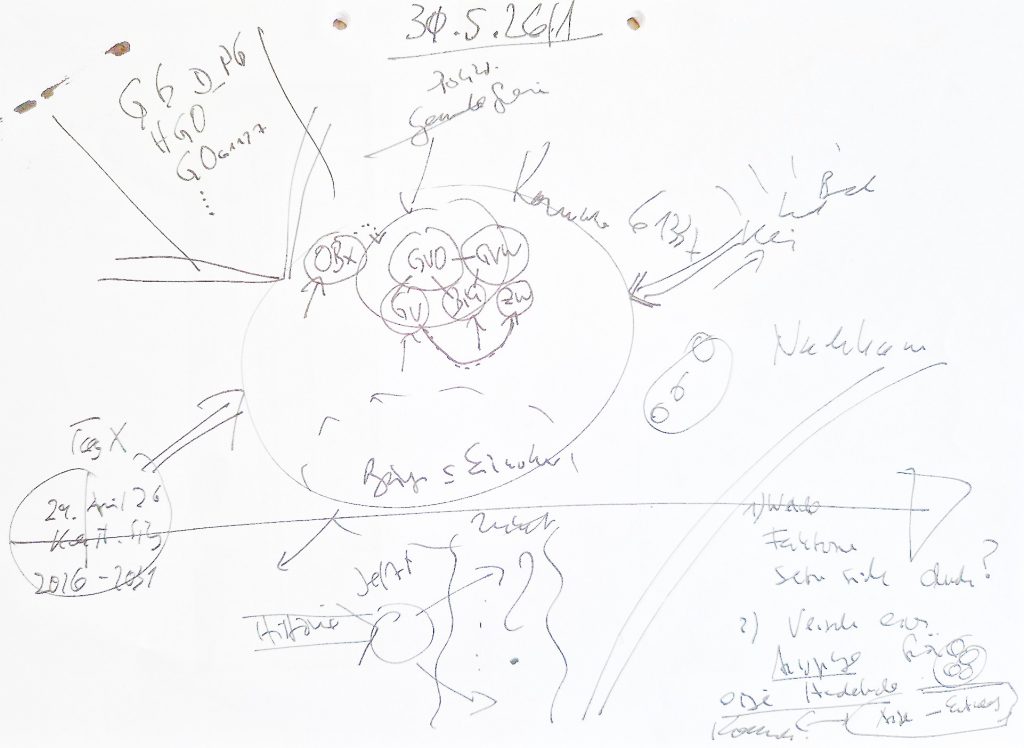
INFO: This graphic renders the thoughts that took place in the run-up to this text and that then became the occasion for writing it. Experience shows that the human Gerd only ever carries over a small part of the image’s aspects into the text that follows.
The point is to briefly describe the most important elements of the starting line-up. This description is necessarily ‘brief’, since listing all the elements would burst every frame. What matters here at the outset are above all those elements that are ‘binding’ for everyone in the ‘social happenings’ in 61137 from the perspective of ‘power’. Of course these elements can change over time, since almost all of them are ‘human-made’, and humans, as is well known, can in principle change anything if they really want to.
At the center of the action stands the municipality 61137 with its inhabitants and its citizens.
The municipality 61137 is ringed by ‘neighbouring municipalities’, is embedded in the district of ‘Main-Kinzig’, which in turn is part of the federal state of ‘Hesse’, which in turn is part of the ‘Federal Republic of Germany’.
Between all of these, many ‘interactions’ take place on many levels.
The aspect of ‘power’ and the ‘exercise of power’ is described — and thereby also indirectly ‘regulated’ — through numerous ‘sets of rules’. Thus, alongside the ‘Basic Law’ (GG) at federal level, there is the ‘state law’ of Hesse, supplemented by the ‘Hessian Municipal Code (HGO)’, and within the political bodies there are further regulations; especially important is the ‘Rules of Procedure of the Municipal Council (GV-GO)’.
In a municipality like 61137, the central bodies for the exercise of power are ‘elected’ every 5 years through Hesse’s ‘municipal elections’. The office of the ‘mayor (BM)’ is likewise filled through elections.
The central body is the ‘Municipal Council (GV)’; it ultimately represents the ‘parliament’ that decides what is to happen in the municipality 61137. Alongside it there is then an ‘executive’ in the form of the ‘Municipal Board (GVO)’, whose members are determined by the GV. The chair of the Municipal Board is the BM. Besides the politically elected bodies (GV and BM), there is also the ‘Municipal Administration (GVW)’, which is headed by the BM.
A peculiar ‘hybrid position’ is held by various ‘advisory bodies’ (local councils, senior citizens’ advisory council, foreigners’ advisory council, …): the members of these advisory councils are individually elected by the citizens, but they have no speaking rights in the parliament. Although these advisory bodies ‘are close’ to many citizens and do excellent work, the parliament has so far tended to keep them ‘on the outside’.
An even more special position is held by the municipality’s ‘Future Workshop (ZW)’. The ZW is a ‘working group’ founded by parliamentary resolution in 2023. Oriented in a non-partisan way, it is meant to fill the ‘space between the citizens and the parliament’ communicatively: What moves the citizens toward the future? Is there something in it that the parliament should take up? On various topics there can be working groups of citizens within the framework of the ZW.
On 29 April 2026, the ‘constituting session’ of the new parliament and of all advisory councils took place in the municipality 61137. With this, a new legislative period of 5 years begins, that is, from 2026–2031.
A new chapter in the municipal history of 61137 opens.
What will happen in the coming years?
From the preceding texts in this blog one can see that human beings — and therefore all citizens too 🙂 — never stand ‘at point zero’ at any given moment. Everyone is shaped by their own prior history, has needs, has their emotions, has their everyday roles, has different plans, is networked in the most varied ways — and what exactly these citizens of 61137 will all do in the coming weeks and months and years, nobody knows.
Of course there are many habits that have formed in everyday life, but habits can change, even if often not easily. Whether a shared shaping of ‘the future’ in the municipality 61137 can succeed depends centrally on precisely this ‘capacity for change’ of all the political bodies and of all the citizens. Even if there are many ideas in the heads of individuals: as long as these ideas are not understood and emotionally affirmed by a sufficient number of citizens, no truly interesting future can take place in 61137.
The author of this text is a ‘citizen of 61137’, he is a new member of the GV, he is a member of the ZW working group, he is a member of the ‘Democracy Lab’ working group, and he is a member of the local branch of Bündnis 90 / Die Grünen. As a scientist the author thinks strictly ‘in a matter-of-fact way’ and is always in search of ‘non-partisan solutions for everyone’.
What happens now?