HISTORY: 6 June 2026 – 6 June 2026
REFERENCE: Experiment No. 25
Human Author: Gerd Doeben-Henisch
Contact: info@emerging-life.org
Asymmetric Symbiosis: Having let the format of the ‘asymmetric symbiosis’ on this blog pass through several transformations, the following format has now settled in: As a rule, the human Gerd first writes his texts completely by himself. Once finished, he enters into a meta-dialogue with the generative intelligence Claude Opus X (currently: X = 4.8). If this meta-dialogue was interesting enough in substance, and the matters at hand go beyond everyday understanding, then the author Gerd asks the AI Claude to compose its own commentary on one — or several — text(s). The text of this commentary is left unaltered by the author Gerd, so as not to obscure the peculiar character of the algorithmic AI perspective.
Everyday Life – Meta-Levels – Action
AUTHOR: the human Gerd
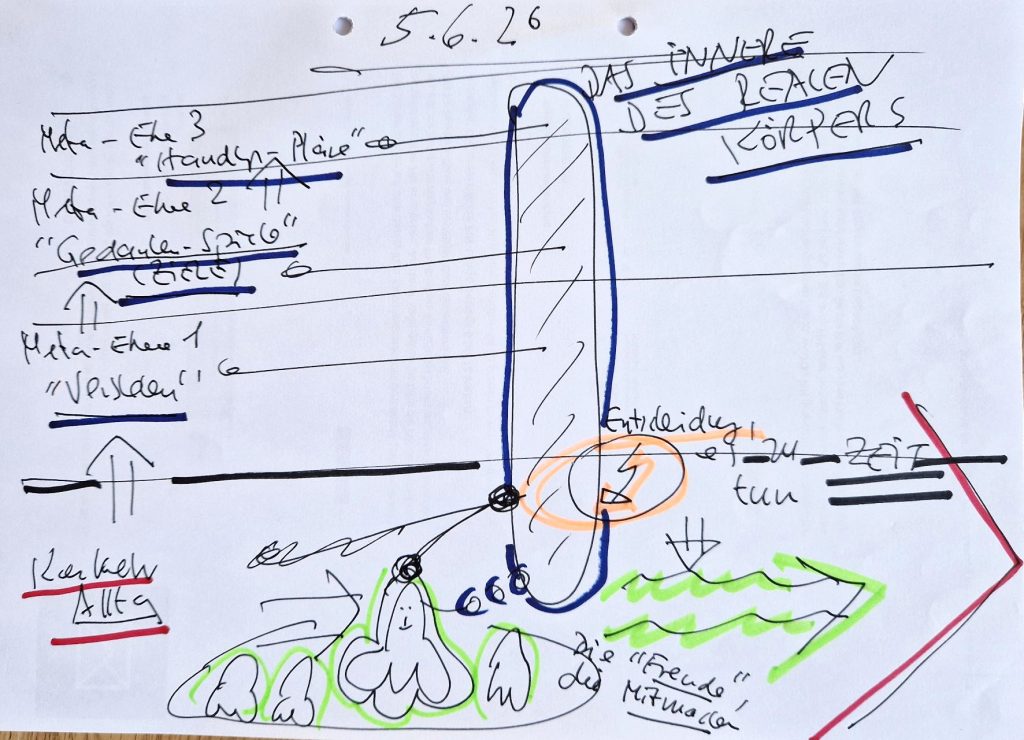
INFO: This graphic renders the thoughts that took place in the run-up to this text and that then became the occasion for writing it. Experience shows that the human Gerd only ever carries over a small part of the image’s aspects into the text that follows.
Starting point
In the preceding Experiment No. 25, one ‘looks at’ the municipality 61137 and asks the question, “What is to be done?” This ‘looking-at’ can be understood as a ‘meta-level’, to be distinguished from the ‘real everyday situation’ in which various real inhabitants, citizens, elected citizens … move about ‘in their everyday life’. Supplied at every moment with a multitude of ‘concrete impressions’, some of them may ask themselves what there is ‘to do’ ‘beyond the accustomed routines of everyday life’, if one tries for once to take ‘the whole’ into account.
This ‘whole’, however, does not exist as a ‘real object’; the ‘whole’ is necessarily a ‘mental construction’, which interested citizens have to work out laboriously in the ‘thicket of everyday impressions’.
Example: the topic of water
Meta-Level 1: Understanding
When an inhabitant of 61137 turns on the ‘tap’ in their flat, then — so far — ‘water’ comes out of the tap. This is an everyday event. One can ‘experience’ it. From this experiencing, however, normally no ‘understanding’ follows: Why does water come out of the tap here?
Such an ‘understanding’ can arise, however, when one knows that the tap is connected via pipes to a ‘water main’ under the street that runs past the house. This water main, in turn, belongs to a whole ‘network of water mains’, which at a certain point is connected to a higher-lying ‘water reservoir’, from where many supply lines lead to the individual houses. These ‘water reservoirs’, in turn, are supplied via a pipe system through which they are ‘pumped full’. The water pumped up here comes from a further network, which pumps water out of, say, ‘wells’, treats it, and feeds it into the supply network. Responsible for all the pipes, pumps and the many ‘accompanying measures’ in the case of the municipality 61137 are the ‘district utilities (Kreiswerke)’ of the Main-Kinzig district. They can distribute water, provided it is ‘available’. Water normally occurs either ‘underground’ (tappable via wells or springs) or ‘above ground’ via rivers and lakes. But this water is ‘not automatically’ available. It always comes from ‘precipitation’, carried through the air by ‘clouds’. Precipitation, however, does not turn 100% into ‘available water’: the greatest part of the ‘down-raining water’ evaporates, some runs off at the surface, some penetrates into the soil and is caught there by the root systems of plants, and a tiny bit seeps further into the ground until it becomes available again at a spring or in a well. The ‘clouds as water-carriers’ come from where there is water that can ‘evaporate’ and rise as water vapour, forming ‘clouds’. The main source of such evaporation processes are the seas and, to a smaller extent, the forests of the continents, which take up water from the soil and release it as water vapour. The increased ‘clearing’ of forests restricts the available water vapour. The rise in the global temperature does increase the evaporation rate from the seas, but these higher temperatures also change the ‘transport of the water through the air’: there come to be ever more energy-rich cloud concentrations, which, in the form of ‘storms’, can destroy land, landscapes and cities ever more severely. The masses of water streaming down are so vast that they can barely seep away; they ‘flood’ the surface. At the same time, the behaviour of the air currents changes with temperature: the ‘accustomed directions’ shift; the whole precipitation behaviour becomes ever more unpredictable.
If one now additionally knows that a municipality like 61137 can obtain only about 15–20% of its water from its own wells (many other municipalities have no water sources of their own at all!), that the supplying district utilities, in turn, also have only 60% from their own springs, wells and lakes, and have to ‘buy in 40% from outside’, then one can sense that the water from the tap is not necessarily ‘self-evident’. If one additionally knows that the ‘groundwater level’ in Hesse, for example, has been continuously sinking for many years, and that temperatures are rising most strongly in Europe in a worldwide comparison, then one might get the idea of thinking a little more about the whole thing.
Meta-Level 2: Thought-Experiments – How to Proceed (Goals)?
Let us assume that someone has neatly written down the knowledge from Meta-Level 1, in such a way that everyone can ‘read it up’ and — hopefully — ‘understand’ it.
Then — and only then — could individual inhabitants ‘think about’ what ‘possible consequences’ this might have for everyday life in the coming years (= ‘future’).
At first glance, from the preceding description one can get the impression that (1) there will be less water, that (2) the occurrence of clouds — if they do come — will, owing to their greater energy, develop a greater destructive force, both ‘directly’ on the landscape, on the buildings, … and through ‘heavy-rain events’.
In so far as one wants to ‘protect’ oneself against these ‘looming’ events in the near future — in many cases already the present — one would have to ‘consider’ what one could actually do here. Can one do anything at all? What could and should one do? Which resources would one need for it? How much time would be necessary to put all this into practice? And a few more questions.
With this, the fundamental question arises of how one can ‘derive predictions’ for a possible future from ‘knowledge at hand’ in the first place. Gathering the individual ‘facts’ together is one thing. The ‘relations’ between these facts is another. But ‘predictions’ would only become possible if one could also, at least rudimentarily, perceive ‘changes’ — that is, ‘sequences of states’ — and thereby determine ‘how the properties of these states change over the course’! Only if one knows, for example, that temperature, cloud formation, groundwater level and so on ‘actually change’, and above all ‘to what extent and at what speed’ they ‘change’, only then does one have first ‘points of reference’ to make, at least rudimentarily, ‘predictions’ that allow us to draw ‘conclusions’ for a ‘possible state’ of our municipality / our district … ‘in the future’.
Meta-Level 3: Forging a Plan
Once a group of inhabitants has mastered the challenges of Meta-Levels 1 and 2, still nothing happens for a long while. It needs a ‘plan’ of what one wants to change, how, with which means, and by when, really in one’s own living world. For this, much know-how is needed, the necessary material is needed, the necessary machines … now it becomes very concrete, very serious, very challenging.
Let us assume that a plan does in fact come about.
Real Decisions
But the successful passage through Meta-Levels 1–3 (which is by no means self-evident — on the contrary, it is very challenging) leads to nothing if not a sufficient number of inhabitants seriously decide to implement a plan that has been worked out.
This can be a pure ‘citizens’ project’, it could be a ‘political project’ that the political bodies have decided on, but it could also be a genuine ‘joint project’ of the political bodies together with the citizens.
For ‘large projects’, which more or less concern everyone, only genuine joint projects should come into question, since a political decision without the support of the citizens can become counterproductive in a municipality like 61137.
Everyday Life as a ‘Dynamic Process’
From these considerations of the preceding sections one can read out that our shared everyday life comprises a multitude of different processes whose ‘inner dynamics’ only open up to us if we seriously try to make ourselves sufficiently ‘aware’ of the various ‘causal connections’ and of the ‘extent of real changes’. And then there will be the point where, ‘on the basis of the knowledge worked out’, one can not only ‘decide’ for suitable measures, but also ‘really must decide’ — unless one wants to walk with one’s eyes open into a future that can do great harm to many people. Put positively: we must really decide, if we want to shape our shared future positively.