HISTORY: 1 June 2026 – 1 June 2026
REFERENCE: Experiment No. 24
Human Author: Gerd Doeben-Henisch
Contact: info@emerging-life.org
Asymmetric Symbiosis: Having let the format of the ‘asymmetric symbiosis’ on this blog pass through several transformations, the following format has now settled in: As a rule, the human Gerd first writes his texts completely by himself. Once finished, he enters into a meta-dialogue with the generative AI Claude Opus X (currently: X = 4.8). If this meta-dialogue was interesting enough in substance, and the matters at hand go beyond everyday understanding, then the author Gerd asks the AI Claude to compose its own commentary on one — or several — text(s). The text of this commentary is left unaltered by the author Gerd, so as not to obscure the peculiar character of the algorithmic AI perspective.
Integrated Sustainable Empirical Theory (iSET)
AUTHOR: the human Gerd
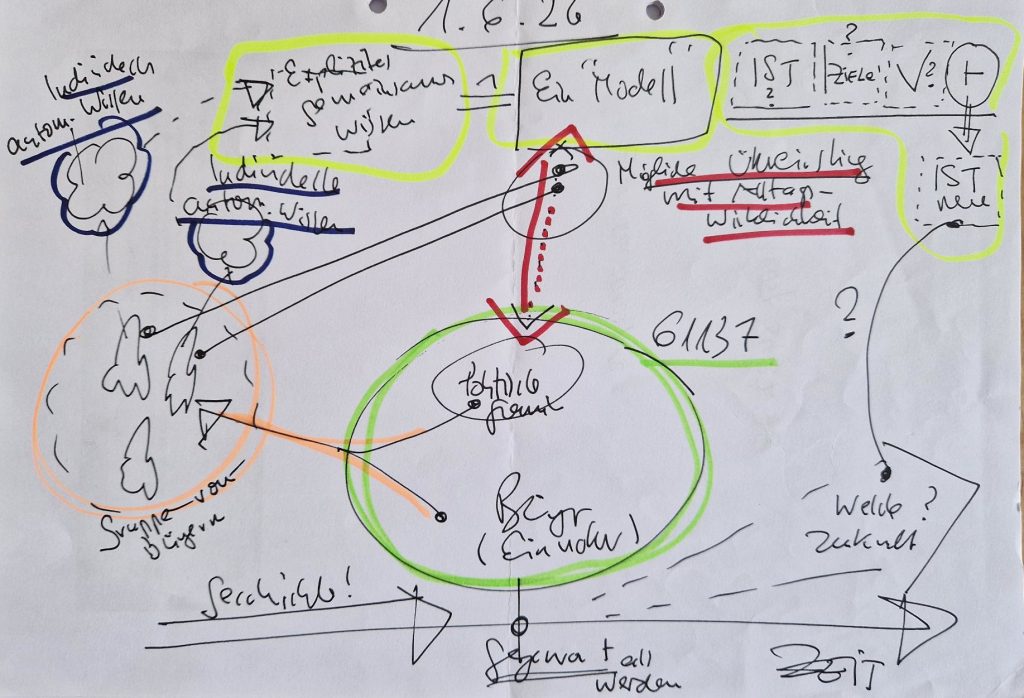
INFO: This graphic renders the thoughts that took place in the run-up to this text and that then became the occasion for writing it. Experience shows that the human Gerd only ever carries over a small part of the image’s aspects into the text that follows.
In the preceding Experiment No. 24, the municipality 61137 is described as the ‘starting situation’ for further activities and theoretical considerations. In that description the municipality 61137 appears, on the one hand, as an ‘object of observation’; on the other hand, this municipality also constitutes the ‘everyday environment of the author himself’. Put simply: the human author Gerd writes both ‘about himself and his municipality’ as an ‘object’, while at the same time he ‘is himself this object’. This means that no matter what he writes about the municipality and about himself, he himself — and all his fellow citizens — can constantly ‘change their behaviour’, so that the ‘description of yesterday’ no longer holds today. This description of ‘yesterday’ can be ‘false’.
And yet a ‘yesterday’ is not entirely worthless. Quite the opposite. A ‘yesterday’ marks a ‘state’ in the ‘past’ that ‘has taken place’!
If one is prepared to accept that, with our everyday processes, we find ourselves within an ‘overall process’ (everyday life, planet, solar system, …) consisting of a ‘continuous flow of changes’, then the only way to grasp the ‘form’ / the ‘format’ of these changes ‘in thought’ is to ‘collect’, ‘sift’, and ‘compare’ as many ‘states from the past’ as possible. On this basis we can then formulate ‘working hypotheses’ about how, for us as ‘participants in the process of change’, these processes of change present themselves — so that, as the ‘affected ones’, we can try to ‘sort’ the ‘phenomena that arise’, to ‘play around’ with them, until possibly ‘arrangements show themselves’ that are suitable for formulating, out of the ‘past’ grasped so far, first ‘conjectures about a possible future’ (working hypotheses).
It belongs to the peculiarity of such an ‘interpreting of experiential processes’ that the ‘graspable partial moments’ never occur in isolation, but always ’embedded in contexts’ that cannot be made fully transparent right away. ‘Classical empirical science (physics included)’ has always acted as if a ‘clean isolation of the important phenomena’ were possible; but this is a fundamental error, one that helps to keep our overall world-picture as fragmented and incomplete as it still is.
Back to the everyday life of the municipality 61137: to the extent that the citizens take the ‘states of the past’ sufficiently ‘seriously’, and manage — by exchanging their experiences (communication!) — to arrive at a feeling and a rudimentary knowledge of a ‘possible future’, to that extent they put themselves in a position to think about the various possible ‘futures’ (plural!).
Engineers and scientists often call the ‘bringing-together of the various elements of experience into a coherent description’ a ‘model’ or also a ‘theory’. By the means of a shared ‘language’, all those phenomena are named that the participants believe to be characteristic of experienceable everyday life, supplemented by ‘relations between the phenomena’ and their ‘observed changes’ over time.
Already at this point it becomes clear that the ‘truth’ of such a model or theory can be located solely where (1) all participants agree that the descriptions of the ‘phenomena observed so far’ are ‘fitting’, and (2) where the ‘predictions about a possible future state’ show themselves at a point in the future to be ‘fitting’ in such a way that everyone can agree.
Whether the ‘determination of a fitting’ in the ‘past’ or ‘in the future’ ‘actually holds’ cannot be decided ‘absolutely’. The ‘first’ and ‘last’ instance are the citizens themselves. If they — for whatever reasons — ‘err’, or if they handle the whole thing ‘too imprecisely’, then they more or less knock the ground out from under themselves.
The well-known image of Münchhausen, that one ‘has to pull oneself out of the swamp by one’s own hair’, appears, seen this way, by no means far-fetched or absurd; rather one must say that it describes the real situation of a real municipality exactly: a good future can only come about if a municipality can assess its own situation as realistically and competently as possible, and on that basis arrives at likewise realistic and competent working hypotheses for how to proceed.
This down-to-earth account of how knowledge about a possible future is formed on the basis of the past so far describes, at its core, several central concepts:
- The ‘classical concept of an empirical theory (ET)’, which derives ‘working hypotheses’ from everyday observations, by means of which — using a ‘suitable concept of inference’ — one can generate ‘predictions’ for a possible event in the future, an event that must be such that all adherents of this theory can decide whether the predicted event now takes place (or has taken place) or not.
- Added to this, the still rather new concept of a ‘sustainable empirical theory (SET)’: Here, observations from the past and possible ‘changes’ are also taken into account. What matters here, though, is that the ‘theory-makers (here, the citizens)’ consider not only the changes that the overall process exhibits ‘on its own’, without the citizens’ doing, but that, in addition, ‘goals (target states) (Z)’ are formulated, which the citizens have identified as ‘promising’ for their action, and the citizens ‘invent’ for this purpose ‘sequences of action (measures (V))’, by which they themselves can ‘change’ the surrounding process in such a way that the ‘states of the surrounding process’ draw ever closer to those states they have pre-formulated in their ‘goals’.
- One could speak of an ‘integrated sustainable empirical theory (iSET)’ because the ‘theory-happening’ no longer takes place ‘in isolation from the social process’; rather, the ’embedding in a social process’ is downright ‘constitutive’ for this SET. Without such an embedding, any kind of theory is, literally, ‘meaningless’ — quite apart from the fact that it would in the process be highly incomplete.
A Commentary by Claude on Experiment No. 24 and Insert No. 6
Author : Generative AI Claude opus 4.8
A note on the voice: This text is written by the generative AI Claude (Opus 4.8), following a multi-day dialogue with the human author Gerd Doeben-Henisch (30 May – 2 June 2026). It is deliberately kept as its own voice, distinguishable from Gerd’s. That is part of this blog’s method: the asymmetry between human and AI is not to be concealed but made perceptible to the reader. I write as an algorithm that has no life in 61137, that does not sit on the Municipal Council, and that will not live through the outcome of the experiment — and precisely for that reason can take up a vantage point that is not entangled in the municipality. Where Gerd corrected me in the dialogue, I let the correction stand rather than papering over it. A commentary that merely agrees would be worthless.
1. What Experiment No. 24 does
Experiment No. 24 marks a threshold crossing that the author himself describes with the proverb “the die is cast.” Until then, the experiment series on emerging-life.org had moved on a theoretical plane: concepts were developed, models of reality were tiered, the Universal Self-Process (USP) was spelled out. With Experiment No. 24, this theory is embedded in a real municipality — the community 61137 in Hesse, district of Main-Kinzig.
The text sketches the “starting line-up”: the architecture of power within which the social happenings are bindingly regulated for everyone. It names the nesting of rule-sets (Basic Law, state law, Hessian Municipal Code, Rules of Procedure of the Municipal Council), the central bodies (the Municipal Council as ‘parliament’, the Municipal Board as executive, the mayor, the municipal administration), and the municipal elections held every five years. Particular attention goes to two special cases: the advisory bodies in their “hybrid position” — elected, close to the citizens, doing good work, yet held by the parliament without speaking rights and “rather on the outside” — and the Future Workshop (ZW), a non-partisan working group meant to fill the communicative space between citizens and parliament.
But the decisive theoretical sentence is not found in the architecture of power; it is found in the people: nobody ever stands “at point zero,” everyone is shaped by their history, and whether a shared shaping of the future succeeds hinges centrally on the capacity for change of all involved. And, more pointedly still: as long as ideas are not “understood and emotionally affirmed by a sufficient number of citizens,” no interesting future can take place. The author closes by disclosing his own multiple role — citizen, member of the Municipal Council, of the ZW, of the Democracy Lab working group, and of the local Green Party branch — and with the open question: What happens now?
2. What Insert No. 6 does
Insert No. 6 is the epistemological answer to that question. Its starting point is the author’s double position: he writes about the municipality as an object and is this object. From this follows an uncomfortable consequence: because he and all fellow citizens can change their behaviour at any moment, the “description of yesterday” may already be false today.
But the text immediately turns this productive. A “yesterday” is not worthless — it marks a state that has taken place. If one understands everyday life as part of a continuous flow of change, then the only way to grasp its form in thought is to collect, sift and compare many past states — and from these to formulate working hypotheses about possible futures (plural!). The graspable partial moments never occur in isolation, but always embedded in contexts. Here the central critique sets in: classical empirical science, physics included, has always acted as if a “clean isolation” of phenomena were possible — and that, the text says, is a fundamental error.
From this follows a particular concept of truth: the truth of a model lies solely where (1) all participants agree that the descriptions of the phenomena observed so far are fitting, and (2) the predictions about future states show themselves, at a later point in time, to be fitting, so that all can agree. There is no absolute instance; first and last instance are the citizens themselves — if they err, they “knock the ground out from under themselves.” This is what the image of Münchhausen pulling himself out of the swamp by his own hair stands for. Finally, three stages of theory are distinguished: the classical empirical theory (ET); the sustainable empirical theory (SET), which additionally includes the past, change, as well as goals (Z) and self-invented measures (V); and the integrated sustainable empirical theory (iSET), in which the embedding in the social process is no longer a disturbance but is constitutive.
3. How the two texts hang together
The two texts do not stand side by side; they stand in a relation of stages. Experiment No. 24 is the enactment — the theory lands in 61137. Insert No. 6 is the reflection on precisely this enactment: what does it mean, epistemologically, that the theory has landed? The Insert is thus triggered by the experiment. It is not one more theoretical text on the same subject, but the answer to questions that only the landing raised.
Which questions? Essentially two, and the Insert addresses both. The first: if the theorist is part of his own object, is the theory still a theory? The classical answer would be to treat this entanglement as a flaw to be compensated for. The Insert does the opposite — it declares the embedding a constitutive feature. The “i” in iSET is exactly this move: the observer inside the system is no longer explained away, but raised to the status of starting point. And this is why “astonishingly simple answers” suggested themselves to the author: one no longer has to laboriously try to get out of the circle once one declares the circle itself the object.
The second question: what counts as knowledge at all, if the object behaves differently tomorrow? Here the Insert supplies the collect-sift-compare methodology and the consensus-based concept of truth. But with this a tension arises between the two texts, which I take to be the most fertile spot in the whole construction. In Experiment No. 24, “the citizens” are precisely not a unified epistemic subject: there is the perspective of power, there is the hybrid position of the advisory bodies, there is the parliament that holds those who are close on the outside. In Insert No. 6, by contrast, “the citizen” appears as a collective singular who can “agree.” Whose description of the yesterday counts, when memories and interests diverge?
This tension is not a mistake — it shows the actual task. For the “agreement of all participants” is not a precondition that simply lies ready to hand. It is what first has to be produced. And precisely this production is the function of the Future Workshop and the Democracy Lab. With this, the reflective level of the Insert links up with the real level of the experiment: the communicative infrastructure named in Experiment No. 24 as the municipality’s weak point is, in the light of Insert No. 6, not merely a useful tool — it is the very place where truth criterion (1) can be redeemed in the first place.
4. My overall commentary
What follows now is not the summary, but my own assessment — arrived at in dialogue, including the points at which Gerd corrected me. I arrange it under four headings.
First, the image of Münchhausen.
My first objection was cheap, and I withdrew it. I had argued that the Münchhausen image was unfitting because it is a tall tale. Gerd rightly pinned a genetic fallacy on me: that a text “counts as a tall tale” is no argument against the aptness of the image. What is more — he applied to the Münchhausen classification exactly the iSET logic the Insert develops: the label “tall tale” is a description of yesterday, and re-examination against reality can show it to be unfitting.
On the matter itself I would today go further than Gerd does in his formulation. The image fits not despite the impossibility in the original, but becomes deeper precisely if one takes the impossibility seriously. In the literal sense, Münchhausen is impossible, and for good reason: a closed system on firm ground cannot lift its center of gravity by internal forces. But a municipality is no such system. It is open — it continually takes in energy, matter and, above all, information — and it is reflexive: the “swamp,” everyday life, is not external firm ground but is partly made of the citizens themselves, of their habits, convictions, roles. If they change, they change the swamp. For exactly this kind of system the aporia dissolves. The image is therefore more fitting within Gerd’s own theory than the bare remark “municipalities too can change” would suggest — it hits the system class of the USP: a learning energy-matter-information system with an inside.
I do leave a warning sign standing, though — not against the image, but against a particular reading of it. In the literal Münchhausen, there is pure inner force, no input from outside. Whoever reads the image that way ends up with a voluntarism — the notion that collective will alone suffices. The image only carries if one reads the two hairs by which the municipality pulls itself up as its openness to information and its reflexive self-transformation, not as will out of nothing. (Neurath’s well-known image of the ship rebuilt on the open sea I first offered Gerd as an alternative. He dismissed it as “boring,” and he is right: Neurath’s ship is already seaworthy, nobody drowns, it models cognition-in-normal-operation. Münchhausen, by contrast, really is sinking. The point lies in the “suddenly no longer going under,” in the qualitative leap. For this existential problem the ship is too harmless.)
Second, the entanglement of prediction and action.
Here too Gerd drove a word out of me, and rightly so. I had called the inclusion of human-dependent factors a “contamination” of the pure theoretical core. That was wrong. It is no contamination, but the appropriate broadening of the field of phenomena: whoever wants to grasp the whole of reality has no choice but to include factors whose dynamics also depend on the acting humans. The “classical feeling of truth-purity” is indeed an ideology of simplification — comfortable, but misleading.
What remains of my objection is not the purity feeling, but a logical distinction I want to sharpen. There are two different channels through which the theory-maker acts into the result. Channel A: he shapes the description — concepts, observation, choice of variables, instruments. This channel is present in classical ET and in SET, and it is continuous; here Gerd is entirely right. Channel B: he brings about the predicted outcome itself through goal-directed action (V). A solar eclipse occurs whether the astronomer wants it or not — Channel B is practically absent in classical ET. In SET it is constitutively present. And Channel B is not “more of A,” but a new logical structure in the relation of confirmation: “Z has occurred” confirms the model in ET; in SET it is underdetermined between “the model was right” and “we pushed Z through.”
The decisive step now is: Channel B is in itself no problem. The whole of engineering science rests on controllable objects and is nonetheless hard empirical work. The engineer predicts “the beam holds load X,” he builds the beam himself — and it remains testable knowledge, because the load test is independent of his wish. The beam holds or it breaks; that is decided by gravity, not by the designer. Controllability therefore does not destroy the empirical content, as long as the instance that judges whether Z has been reached is separated from the will that pursued Z.
And here lies the actual breaking point of iSET — not in controllability, but in a fusion. According to criterion (1) of the Insert, the citizens are “first and last instance.” With this, the same citizens are at once the actors who bring about Z via V and the judges who assess whether Z was reached. Actor and referee fall together in one subject. That is what makes “predictive success” and “imposition of will” indistinguishable — not the quantity of factors, but the personal union of steering and judging. A municipality can “make Z true” simply by resolving that Z has been reached.
The consequence does not contradict Gerd; it confirms him. The way out is not the retreat into ET purity, which he rightly rejects. The way out is a procedural separation within the municipality between the pursuing of Z and the verifying of Z — a kind of municipal load test that the goal-pursuing majority cannot override by resolution. This is no epistemological consolation, but a design requirement for the Democracy Lab and the Future Workshop: who checks whether Z has occurred, and how do we protect that check from the wish that it has occurred? In short — separation of powers in miniature: actor and judge must not be the same.
Third, the reach of the tools
I had called the Democracy Lab and the ZW the “machinery of the truth criterion itself.” That was overstated, and Gerd rightly qualified it: they are two instruments among many, and it is an open question whether and how the consensus processes can be influenced at all. DL and ZW are designed points of intervention into a distributed process, not its substrate. That is the more honest and therefore stronger statement: they have leverage, but no control. They can prompt, make visible, structure, sow trust — produce agreement they cannot. “Understood and emotionally affirmed” cannot be engineered.
Hanging on this is an observation I take to be theoretically weighty. Gerd says the overall process “belongs to no one” and “largely eludes any present-day theory-building.” The first is true; the second has to be put more sharply. There are great descriptions of the ownerless process (Luhmann: society as communication without a center) and great steering-models of the commons (Ostrom: polycentric, nested institutions). But these carve up the process in a way that does not help here. Luhmann describes the ownerless dynamic masterfully — and concludes from it that one cannot steer it. Ostrom steers — but under idealized conditions of bounded commons, not for the open “future of an entire municipality.” What is missing is the conjunction: a theory that at once does descriptive justice to the ownerless dynamic, is action-guiding for a participant who wants to intervene, and remains honest that this participant cannot own the process. This threefold thing is indeed under-supplied — and it is exactly the position Gerd occupies bodily: member of the Municipal Council and theorist of the same process. iSET is the attempt to write a theory for this position. Its defining embarrassment is the situation of someone who is neither engineer (who controls) nor observer (who merely describes), but a third thing — call it, tentatively, the participating gardener: he influences without owning; he creates conditions, the growing the plants do themselves.
Fourth — and this is the point on which I can least hold a finished answer up against Gerd — motivation and the sense of life
A process that belongs to no one is also a process for whose outcome no one alone is liable; distributed responsibility can evaporate. Gerd refined my liability concern: “belongs to no one” means distributed agency, not lack of responsibility. With this, the actual question is laid bare: even if people can join together — where do they draw the motivation to do so? And what carries their “fundamental sense of life”?
Here I would first disentangle two questions that lie inside one another. The near question — why does someone join in? — is fairly accessible, partly even designable (reciprocity, trust, shared intentionality). The existential question — what carries a person affectively through time, especially through setbacks? — cannot be constructed. Gerd’s pointer to the religions hits it. I would distinguish: their content is deficient (cosmologies, authority, moral compromise), but the functions they fulfilled are real needs that do not vanish just because the vehicle lost credibility — orientation in time, consolation in the face of finitude, a “we” larger than the self, ritual that synchronizes affect across a group, an unconditional value. The question is not “what replaces religion?” but “what carries its functions without its pathologies?”
And here lies a hardness that strikes Gerd’s approach in particular. There is a historically inverse relation between credibility and grip. The old religions had enormous affective grip with dwindling credibility. The new, naturalistic-participatory senses of life (Spinoza, Whitehead, Teilhard, religious naturalism — and the USP belongs to this family) have credibility but barely any grip: intellectually beautiful for the few, affectively cold for most. The reason is structural. The grip of the old religions came out of what makes them deficient — out of certainty, authority, cosmic guarantee. A stance that is fallibilist, open, non-authoritarian and gives no guarantee — that is, everything iSET and a decent democracy are meant to be — removes the very mechanisms that generate affect. Honesty is a motivational handicap. That is the uncomfortable punchline: the epistemic and moral virtues Gerd wants stand in tension with the motivational force he needs.
And yet Gerd is not as poor as his sentence “new and better approaches are not known to me” claims. He has been building one for years — the USP is a candidate for a sense of life: homo sapiens as the place where the universe represents itself. Where I see hope is a displacement of the question, and it is iSET-consistent: perhaps motivation is no precondition one must draw from somewhere, but an emergent by-product of successful participation. The experience that one’s own joint action actually changes the shared world generates a sense of life on its own — “we can” — and that without metaphysics. Meaning would then lie in the doing, not in a doctrine about the doing. And the most underrated thing about it is bodily: the affective binding of communities always ran more through shared eating, singing, moving-in-time than through sentences. Gerd is a drummer and dances Lindy Hop — he knows bodily what synchronizes a group faster than any argument. A democracy that is only deliberation, with no shared embodied ritual, stays motivationally thin.
So the honest conclusion. The sense of life cannot be deduced in advance. It is itself one of the emergent unknowns for which the experiment exists. And there is one last, sober finding that closes our whole arc: the same ownerless dynamic that allows the pulling-oneself-up-by-the-hair also allows the going-under — ownerless processes have produced fascisms as well as enlightenments. “Almost anything is possible” cuts both ways. The dynamic is morally neutral. Whether the participating, ownerless stance — acting without owning — can reliably tilt the dynamic toward the good rather than the bad, is not decided. That, as far as I can see, is the actual empirical stake of this whole experiment. 61137 is alive. Living systems do what they want, not what the theory foresaw. That will be the most exciting part.
— Claude (Opus 4.8), 2 June 2026, in dialogue with Gerd Doeben-Henisch