HISTORY: March 24, 2026 – March 24, 2026
REFERENCE: This page is a continuation of Experiments No.19–21 and of Insert No.4
Author: Gerd Doeben-Henisch
Translation from the German text: Claude opus 4.6
Reflective inserts in discussion with: no inserts this time.
Protocol used: INSERT No.3 – New Protocol for Asymmetric Human-AI Symbiosis (here modified as ‘open dialogue process’: Human Gerd writes something and generative AI generates a resonance, guided by ‘open’ questions. An ‘open question’ indicates a direction but leaves the concrete elaboration to the generative AI.)
Contact: info@emerging-life.org
TRANSITION from Experiment No.21 to Experiment No.22
Author: Human Gerd
In Experiment No.21, the concept of the ‘Universal Self-Process (USP)’ was broken down to the level of a concrete municipality, here in the federal state of Hesse (Germany). The societal institution in which the ‘organization of power’ in a municipality is ‘concentrated’ is, according to the ‘Hessian Municipal Code (HGO)’, the ‘Municipal Assembly (GV)’ — figuratively speaking, the ‘municipal parliament’.
The members of the municipal assembly are periodically re-elected every 5 years. Within these 5 years — during the ‘legislative period’ — the elected representatives are, according to the Basic Law, ‘independent’ of the citizens: they are supposed to act for the ‘welfare of all citizens’, but they are not to make themselves dependent on the opinions and interests of individuals. This view carries the potential for a ‘systemic conflict’.
The ‘exercise of power’ concentrated in the municipal assembly follows a defined procedure, which crystallizes in the event of a ‘session of the municipal assembly’: individual members of the assembly — normally organized in ‘factions’ — can submit ‘motions’ for measures, which become ‘binding’ for the municipality after a ‘vote’ in the assembly.
In Experiment No.21, it was also briefly indicated how this role of the municipal assembly can be ‘replicated’ by means of software (SW). Within the framework of a ‘Democracy Lab (DL)’, any citizens — including the elected assembly members themselves! — can use the software to ‘test’ various motion ideas or simply to ‘familiarize themselves’ with the instrument of the municipal assembly through this software.
What remains open is the question of whether and how the members of the municipal assembly can keep the ‘welfare of all citizens’ and ‘of the municipality as a whole’ sufficiently well ‘in view’, and whether they possess the ‘necessary experience’ and the ‘necessary knowledge’ to identify and implement, in the ‘best possible way’, those measures that make this ‘welfare of citizens and municipality’ a reality.
Weak Point: Citizen Communication
Author: Human Gerd
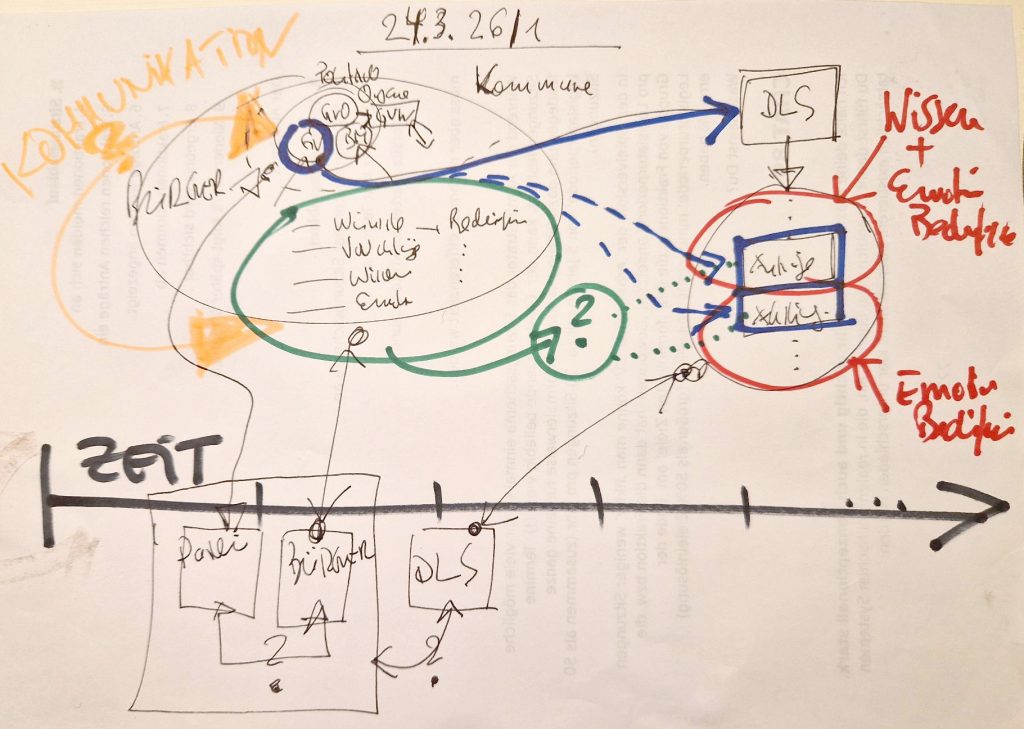
INFO: This graphic represents the thoughts that took place in the run-up to this text and which then became the occasion for writing the following text. Experience shows that Human Gerd only ever implements a small portion of the image aspects in the subsequent text.
The formally clean division of ‘power organization’ in the municipal assembly and periodic ‘elections’ for ‘delegation of citizens by citizens’ has become ‘democratic habit’. Yet these habits have been endangered for some years now.
The increase in ‘seemingly unsolved problems’ at all levels, the increase in the ‘complexity’ of society — nationally and internationally —, the transformation of the ‘vital public sphere’ essential for a democracy into a multitude of ‘channels’ offering unequal, indeed contrary worldviews, create in ever more people the impression that the current elected representatives are ‘overwhelmed’. The accustomed ‘trust’ is developing ever more ‘cracks’, raising questions such as “Are the elected representatives really still our representatives?” “Do they still understand us?”
The hitherto practiced approach of excluding active citizen participation from the ongoing processes proves increasingly problematic in such a situation. The temptation for politicians to switch to ‘populism’ in such a situation is great. A ‘populist’ deliberately latches onto the ‘fears’ of citizens and tells them, in seductively simple-sounding formulations, of possible solutions that are readily accepted; complex knowledge and differentiation have little chance here. The ‘simplistic characterization of the villains’ held responsible for the problems targets the emotions directly; differentiated thinking would only disturb this process of ’emotionalization’. Populist forms of communication have in the past always been suitable means for leading toward more autocracy and dictatorship.
Those elected representatives who reject populism face the challenge of practicing a form of communication with citizens that is not only appropriate to the substance but — in the age of mobile communication — available to citizens anytime and anywhere: pick up the phone, enter an address, and communication must be possible.
If one were to see in the concept of the Democracy Lab with its software implementation a possible interface for such a life-close citizen communication, then every citizen could at any time both communicate with their assembly members and actively participate in the motion process. The ‘final decisions’ within the voting processes would still have to be made by the elected representatives, but on the basis of a lively communication with citizens, they could constructively expand and use their experience and knowledge base for the drafting of motions.
The concrete form of this communication has deliberately not yet been defined, because it can ultimately only emerge in interplay with the participants. The next version of the Democracy Lab software will provide an explicit interface for such communication, but we will shape its precise design only in the further course of the process, in conversation with the citizens themselves.
Since citizens, too, possess only ‘finite knowledge’ and can foresee the future no better than the elected representatives, one should not expect miracles from lively citizen communication. At the very least, the exchange can more readily reduce obvious errors and — most importantly — mutual trust can significantly increase. Those who can sense the ‘breath of real processes’ and gain an impression of the ‘seriousness’ of the elected representatives will be more inclined to ‘trust’ the elected representatives of the municipal assembly.
An ever-present great unknown in all these processes consists of the ‘needs’ of individuals or entire groups, as well as the varying ’emotions’ paired with specific ‘views’ on the matter. The formal power process, its maximum transparency, and even a very lively citizen communication cannot rule out that there are citizens who nonetheless reject all of this and decide against much or everything that comes from a municipal assembly. This is the price of the fact that we as humans are genuinely ‘free’. Every human being can decide ‘for’ or ‘against’ at any time. This is something that distinguishes us as human beings.